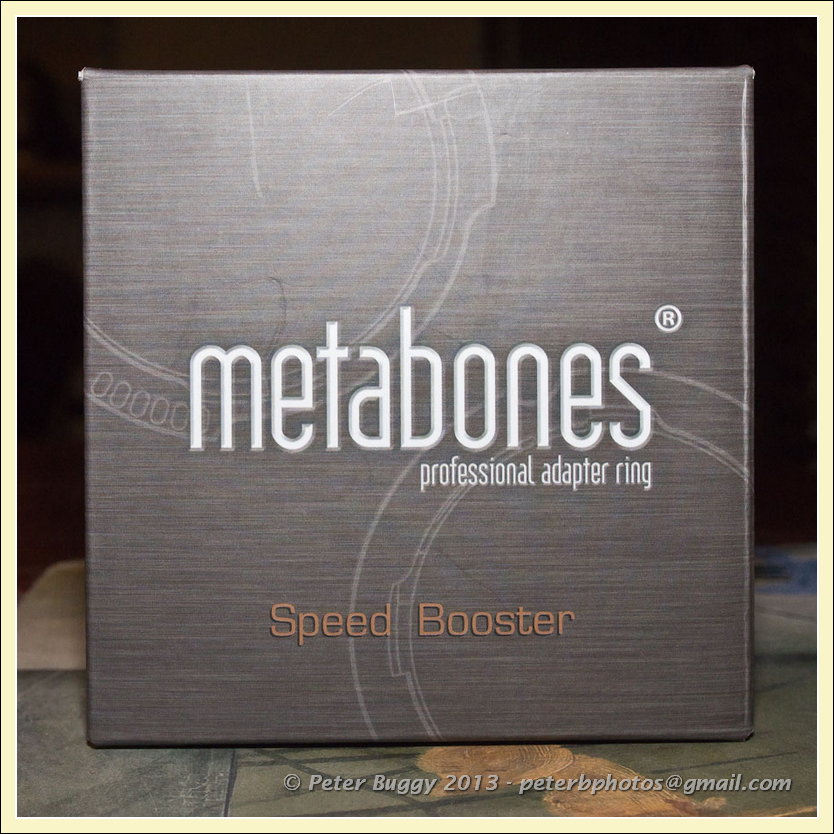
I have been waiting for the Nikon to Micro Four Thirds Speed
Booster from Metabones for a little while now. It was announced back in January
and now, 6 months later the Nikon to MFT version has hit the scene. Within a
couple day or two of the announcement, I checked my bank balance and placed my
order. Around 3 days later, a little parcel arrives at my work desk in Sydney
all the way from Hong Kong. I have to say I am impressed at how quickly it got
to me.
The build quality is very good. The body is metal; the
aperture control has engraved markings and is indented for half-stops. The
4-element lens unit is a solid looking piece and it all seems to be put
together well.
What's in the box?
The Speed Booster comes well packed but there is no pouch to
store the adapter in. It comes with front and rear caps. One being their
version of Nikon body cap, the other being their version of a Panasonic rear
lens cap. Unlike the body of the Speed Booster, neither are well made but do work. I tried using a Nikon body cap but the fit is
too loose.
Also in the box, you get a couple of hex keys in a plastic bag to remove the tripod adapter. There are no instructions or guide on how to use the unit.
The elements of the Speed Booster are a little exposed at the MFT
end and I wouldn't recommend using an Olympus cap - it seems as though it would
be very close to the lens element. The Panasonic style cap would be a better
choice and get over the slight nastiness of the supplied cap.
Putting Camera, Speed
Booster and Lens Together
Attaching the Speed Booster is fairly easy. While it doesn't
mount as smoothly as say an Olympus lens on my OM-D and likewise, Nikon lenses
feel that great when rotating them, I have had worse. This was a little
surprising considering the apparent high build quality. On the Metabones web
site it says to rotate the Speed Booster ring to 8 before mounting the lens. I
don't think failing to do so would damage your lens or the Speed Booster, but
it may make it more difficult to lock the lens should you not when the aperture
tab on the lens is pushed up against the Metabones aperture control link.

There is a compact tripod mount on the unit and this is
threaded for a quick release plate, or you can use it directly in a Arca Swiss
style tripod clamp. It looks very short for the latter but works well for any
lens that does not have its own tripod clamping ring and gives good balance
with a standard zoom and with the relatively light weight of MFT cameras, just
right for these lenses. Obviously, if using something like a Sigma 150-500mm
zoom you would use the lenses tripod mounting ring.
Well how does it
work?
Well I must say I am pleasantly surprised. In a word -
excellent!!!! I was expecting the sort of degradation you get when you when you
use a teleconverter. It seems excellent from fully open with the lenses I have
used.
So far I have had a play with an ancient Nikon AF Nikkor
24mm f/2.8. This is a pre-D lens and not one of Nikon's best. When mounted, it
becomes a 35mm equivalent at f/2. This lens suffers from flare and it seems no
worse for the Speed Booster despite adding 4 lens elements into the equation.
As a full-frame lens, there is no light fall-off and sharpness does not suffer.
Not an excessively large combination and easy enough to use. I wouldn't say it
is a substitute for something like the Olympus 17mm f/1.8 which remains on my wish
list.
Next play was with the Tamron 60mm f/2 macro. This is a DX
format lens and it becomes the equivalent of an 85mm f/1.4 (sort of). I don't
consider this lens a true f/2 as it is only f/2 at around 3m and longer. As an
internal focusing macro lens, the focal length increases the closer you focus
and the aperture falls. It is around a f/2.5 at closest focus. Still, the extra
speed makes a nice bright viewfinder and the generous focus ring rotation of
the lens makes it easy to focus. The Tamron 60mm is ultra-sharp on my Nikon and
just as sharp on the Olympus.
OK, now for the real test. My Nikon 10-24mm f/3.5-4.5 zoom
is probably my most used Nikon lens. With the Speed Booster on my Olympus OM-D
this becomes an equivalent to a 14.2-34mm f/2.5-3.2. This is a lot faster (1
2/3 stops) than my Olympus 9-18mm (18-36mm equivalent) f/4-5.6 zoom goes
substantially wider and almost as long. First impressions indoors I noticed
quite a bit of vignetting. In the field, this does not seem to be an issue,
probably due to the longer focus distance slightly increasing the focal length
- who knows. It gives a fair bit more in field of view than the Olympus wide
zoom and again very sharp. One disadvantage of the 10-24mm lens is the
relatively short focus scale but the wider focal length afforded by the Speed
Booster seems to overcome any issues here and the 14x screen magnification
available for the Olympus OM-D makes focusing not ultra-critical.
The results show in the photos.
Tamron 60mm macro - a tiny flower at closet focus and stopped down quite a bit.
Nikon Nikkor 10-24mm f/3.5-4.5 at 24mm
From the same spot - Nikon Nikkor 10-24mm f/3.5-4.5 at 10mm
Nikon Nikkor 10-24mm f/3.5-4.5 at around 18mm
Conclusion
The Speed Booster is not cheap and costs about the same as a
mid-priced consumer level fixed focal length lens or one of the cheaper non-kit zooms.
If you have a couple of lenses sitting in your kit bag for a Nikon camera, it
can be a bargain. There seems to be no real image quality issues with using the
Speed Booster and for low-light work - a real treat. With DX lenses and the
0.71x magnification of the Speed Booster, you have a lot more wide options for
the Olympus system.