Monday, 26 May 2014

The camera you take when not taking a camera - Review of the Sony DSC-HX50V

There are many times that I have been strolling/bush walking or out for a short drive when I have wanted to take a photo and all I have is my camera phone which basically sucks in most situations. Maybe you want to go on holiday and travel very light.

I have had simple point and shoot cameras in the past and thought it may be time to re-visit one as a pocket camera for times like above. My partner, Chris isn't one to twiddle with settings to get the best photo and we are often out where she wants to take a snap. While Chris tends to spend large sums of the latest mobile phone, some of which have half-decent cameras, they often come up wanting in anything remotely challenging.

I bit the bullet and was about to buy a Samsung WB350. Not the greatest of cameras but just right for Chris and acceptable photo quality for sharing. The WiFi functionality was a big drawing point for Chris. The price was great as there was a sale on but now living outside a large metropolis, by the time Chris got to the store, the sale was over and the camera had gone up in price from around $249 to $299 (everything is more expensive in Australia). For just a couple of dollars more, it was possible to do much better. I had seen the Sony DSC-HX50V for sale for $349. While it had been superseded, the reviews were good and it seemed like much better value. According to Internet, my local electronics store had the newer version for sale at $449 but that was getting a bit much (and quite often they need to order in stuff). What a surprise when I popped in and saw the Sony DSC-HX50V for $349. A little bit of haggling and it was mine for $329 or just $30 more than the Samsung.

The camera is small, amazingly small for a camera with a 30x zoom lens. Frankly, if the body was any smaller, it would be cramped. Build quality is solid and controls are well placed. It even has an external flash shoe of a Sony design for their fancy (overpriced) accessories that will take a standard ISO shoe flash. Tried it out with my Olympus FL14 flash on the "auto" setting and it works fine after a little experimentation with settings (and greatly extends the flash range).

About the only comment regarding the build quality would be the battery door which is a little too easy to open accidentally.


Taking pictures - I trialled the camera on the "Superior Auto" mode as this is what Chris would most likely be using and the results are impressive. Best to look at the results. All shots are hand-held, the camera has chosen all settings and none have been overridden, some night shots have ISO boosted to 12800 and have come out surprisingly well. Maybe not for printing wall sized posters but ideal for social media, general viewing online and printing small prints. Images shot in better light where ISO is kept to ISO 800 are excellent. A big improvement over a mobile phone and certainly better than any of the compact cameras I have had in the past.


Credit - the last 3 photos were taken by Chris.

Saturday, 13 July 2013

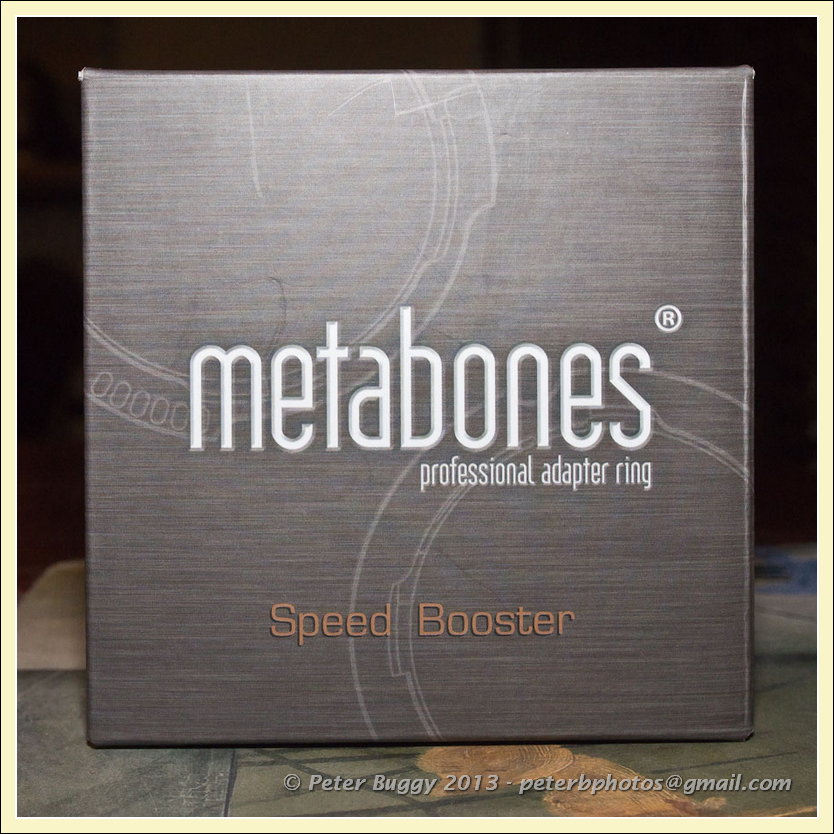
Metabones Nikon to Micro Four Thirds Speed Booster Review

I have been waiting for the Nikon to Micro Four Thirds Speed Booster from Metabones for a little while now. It was announced back in January and now, 6 months later the Nikon to MFT version has hit the scene. Within a couple day or two of the announcement, I checked my bank balance and placed my order. Around 3 days later, a little parcel arrives at my work desk in Sydney all the way from Hong Kong. I have to say I am impressed at how quickly it got to me.


The build quality is very good. The body is metal; the aperture control has engraved markings and is indented for half-stops. The 4-element lens unit is a solid looking piece and it all seems to be put together well.

What's in the box?


The Speed Booster comes well packed but there is no pouch to store the adapter in. It comes with front and rear caps. One being their version of Nikon body cap, the other being their version of a Panasonic rear lens cap. Unlike the body of the Speed Booster, neither are well made but do work.  I tried using a Nikon body cap but the fit is too loose.

Also in the box, you get a couple of hex keys in a plastic bag to remove the tripod adapter. There are no instructions or guide on how to use the unit.

The elements of the Speed Booster are a little exposed at the MFT end and I wouldn't recommend using an Olympus cap - it seems as though it would be very close to the lens element. The Panasonic style cap would be a better choice and get over the slight nastiness of the supplied cap.

Putting Camera, Speed Booster and Lens Together

Attaching the Speed Booster is fairly easy. While it doesn't mount as smoothly as say an Olympus lens on my OM-D and likewise, Nikon lenses feel that great when rotating them, I have had worse. This was a little surprising considering the apparent high build quality. On the Metabones web site it says to rotate the Speed Booster ring to 8 before mounting the lens. I don't think failing to do so would damage your lens or the Speed Booster, but it may make it more difficult to lock the lens should you not when the aperture tab on the lens is pushed up against the Metabones aperture control link.


There is a compact tripod mount on the unit and this is threaded for a quick release plate, or you can use it directly in a Arca Swiss style tripod clamp. It looks very short for the latter but works well for any lens that does not have its own tripod clamping ring and gives good balance with a standard zoom and with the relatively light weight of MFT cameras, just right for these lenses. Obviously, if using something like a Sigma 150-500mm zoom you would use the lenses tripod mounting ring.

Well how does it work?

Well I must say I am pleasantly surprised. In a word - excellent!!!! I was expecting the sort of degradation you get when you when you use a teleconverter. It seems excellent from fully open with the lenses I have used.

So far I have had a play with an ancient Nikon AF Nikkor 24mm f/2.8. This is a pre-D lens and not one of Nikon's best. When mounted, it becomes a 35mm equivalent at f/2. This lens suffers from flare and it seems no worse for the Speed Booster despite adding 4 lens elements into the equation. As a full-frame lens, there is no light fall-off and sharpness does not suffer. Not an excessively large combination and easy enough to use. I wouldn't say it is a substitute for something like the Olympus 17mm f/1.8 which remains on my wish list.

Next play was with the Tamron 60mm f/2 macro. This is a DX format lens and it becomes the equivalent of an 85mm f/1.4 (sort of). I don't consider this lens a true f/2 as it is only f/2 at around 3m and longer. As an internal focusing macro lens, the focal length increases the closer you focus and the aperture falls. It is around a f/2.5 at closest focus. Still, the extra speed makes a nice bright viewfinder and the generous focus ring rotation of the lens makes it easy to focus. The Tamron 60mm is ultra-sharp on my Nikon and just as sharp on the Olympus.

OK, now for the real test. My Nikon 10-24mm f/3.5-4.5 zoom is probably my most used Nikon lens. With the Speed Booster on my Olympus OM-D this becomes an equivalent to a 14.2-34mm f/2.5-3.2. This is a lot faster (1 2/3 stops) than my Olympus 9-18mm (18-36mm equivalent) f/4-5.6 zoom goes substantially wider and almost as long. First impressions indoors I noticed quite a bit of vignetting. In the field, this does not seem to be an issue, probably due to the longer focus distance slightly increasing the focal length - who knows. It gives a fair bit more in field of view than the Olympus wide zoom and again very sharp. One disadvantage of the 10-24mm lens is the relatively short focus scale but the wider focal length afforded by the Speed Booster seems to overcome any issues here and the 14x screen magnification available for the Olympus OM-D makes focusing not ultra-critical.

The results show in the photos.
  

Tamron 60mm macro - a tiny flower at closet focus and stopped down quite a bit.


Nikon Nikkor 10-24mm f/3.5-4.5 at 24mm


From the same spot - Nikon Nikkor 10-24mm f/3.5-4.5 at 10mm


Nikon Nikkor 10-24mm f/3.5-4.5 at around 18mm


 Conclusion


The Speed Booster is not cheap and costs about the same as a mid-priced consumer level fixed focal length lens or one of the cheaper non-kit zooms. If you have a couple of lenses sitting in your kit bag for a Nikon camera, it can be a bargain. There seems to be no real image quality issues with using the Speed Booster and for low-light work - a real treat. With DX lenses and the 0.71x magnification of the Speed Booster, you have a lot more wide options for the Olympus system.

Friday, 5 April 2013

SLR Magic Hyperprime 12mm Cine T1.6 Lens Review


OK, let's start off the review of a series of long-exposure, low light photos taken with the SLR Magic Hyperprime 12mm Cine T1.6

This series of sunrise photos taken at Cronulla this morning with the SLR Magic Hyperprime 12mm using my Olympus OM-D E-M5.

#1

#2


#3


#4

#5

About the only area where you could criticise the performance of this lens is shooting into the sun or a bright source of light where lens flare and internal reflections are a problem. That said - it is no worse than a complex zoom lens, say for example the Olympus 12-50mm zoom. Vignetting is also high but easy to fix in post processing. Fringing is about average and distortion fairly low.

Build quality is excellent. The focus ring is firm and while well damped, not as smooth as say a Voigtlander focus ring and there is a tiny little bit of play in it when you change direction. Still well above average in and vastly superiour to the manual focus rings you get on AF lenses. There are a few exposed but recessed screw heads and the lens mount is not separate, i.e. it is integrated into the housing.

The lens feels very heavy when not mounted on a camera but is nicely balanced on the Olympus OM-D E-M5.

The optional lens hood step-up ring is a rip off. It it little more than a slightly dished step-up ring and is certainly not optimised for the angle of view of the lens. I think a much cheaper 58mm to 77mm stepping ring would be fine along with a 58mm wide angle lens hood (probably a bit difficult to source a 77mm one that is not a bayonet fitting).

Overall, this is a great little lens. Works well in early morning landscape and seascape photography. Good value for money if you don't need auto focus.

Saturday, 9 February 2013

Olympus 15mm Lens Cap Lens - mini review

When I bought my Olympus OM-D E-M5, Olympus Australia had a promotion where you got a small bundle of goodies by redemption. The goodies included a lens cap lens, leather camera strap and a camera wrap. The 15mm lens cap lens is the subject of this review.

Lens Cap Lens is a good description and it is a fun little thing that is little more than the depth of a standard lens cap. It is made of 100% plastic and I believe it is a simple 3-element lens.


I like the lens on the E-P3 - the combination is truly pocketable - even in a shirt pocket - but I would be very caution of putting it into a shirt pocket. I don't like the feel of the lens on the OM-D as it doesn't feel right as the OM-D camera design provides a less positive grip compared to the standard screw-on grip of the E-P3.

Coming from the SLR world, it feels a little strange not having a lens barrel as part of the means of holding the camera but you soon get use to it - holding the camera like a point and shoot device.

The only control on the lens is a slider that reveals the lens and provides a simple focus adjustment. Other than closed, focus adjustment has 3-stops - infinity, a mark for the hyper-focal distance, and 0.3m. The control itself is fairly sloppy and too light. There are indents for the hyper-focal distance which is reasonably secure enough, and an exceedingly light one for infinity. You just slide the control all the way to the 0.3m end for the close focus.

Checking a depth of field calculator, the hyper-focal distance at f/8 (the only aperture you get for this lens) is approximately 2 metres. Everything from around 0.9 metres should be in focus.

Sharpness ins't strong at the hyper-focal distance and I often find infinity is a better option. This should have everything from around 1.4 metres should be in focus.

The close focus setting should have a depth of field of about 90 mm.

The lens works but expectations should not be high. The small aperture of f/8 makes focusing difficult - even when magnified on the screen so distance guesstamation is best. The lens has all the sharpness of a 'toy' lens and on the Olympus OM-D or E-P3 makes a very expensive way of getting pictures that are not particularly sharp but then this will never perform like a proper lens. Overall - the images are fine for posting on the internet or even viewing at reasonable sizes on a computer screen. I expect they would look fair enough printed out to 6x4 size but forget about doing an A2 poster print.

I got the lens for free and it is a lot of fun - especially when used with the Olympus ART filters. The focus lever needs to be more firm and the infinity indent more positive.

The lens sells for around USD49 in the US (less than $48 dollars in Oz currency) but $99 in Australia. What is it with Olympus in Australia? There is no excuse for the more than doubling of the price. At $49 it would be a good buy but questionable at $99.

Here are some pictures done in grainy black and white...


Monday, 24 December 2012

I have had my Olympus OM-D E-M5 and the 12-50 mm kit lens for about 3 weeks now and I am constantly amazed by this piece of kit. It seemed expensive at the time but the image quality is excellent, heaps better than the Olympus Pen E-P5, and the 12-50 mm kit lens is very useful being weather proof, macro (approximately half life-size) and going to a respectable 24 mm full-frame equivalent.

Here is a photo from the kit lens in macro mode, hand-held and at a distance of approximately 0.3 m (or 1 foot in the old language).

Cuttagee Beach jpg

This image is larger than real life even at this modest image size. Macro mode sets the zoom to a fixed focal length of 43 mm. The fold out LCD made this close to ground shot very easy and it was still clear enough in full-sun to frame the image. Quite surprised.

Travelling with the Olympus OM-D and the 12-50mm kit lens seems like an almost perfect holiday combination and gives incredible image quality for the size and cost.

Saturday, 8 December 2012

Olympus OM-D and Olympus 12-50mm First Impressions Review


Not an early adopter as I was with the Olympus E-P1 and E-P3, I have finally managed to get around to buying an Olympus OM-D E-P5 with the 12-50mm zoom. I was originally going to get the body only but the price difference between the body and 12-50mm kit price wasn't great, so thought it may be useful to have a weather-proof lens.

Initial impressions were mixed but it didn't take long to realise that good things do come in small packages and the benefits of the OM-D are quite deceptive.

The fold out LCD is brilliant and I love the EVF - nice, large and bright. It is taking a little while to get use to the controls. I like the positive nature of the on-off switch, but I am less warm about the location of the switch. I guess I have to get use to it. The size and location of the playback and Fn1 buttons is poor but I will get use to it. The lack of labelling on the control buttons is odd but understandable - I have reassigned most of the buttons to suit my needs anyway. In general the controls are more positive than on the E-P1 and E-P3 and the off-set location of the two control wheels took a little while to get use to. Overall-  a lovely body and great to use.

The 12-50mm lens was a real surprise. It has had some poor reviews and I am less than excited about the f/6.3 aperture at the wrong end. The lens cannot even manage to maintain f/3.5 at 14mm and is a poor f/5.1 at 25mm. This really isn't good enough. The lens should be a half a stop faster across the entire range.

The macro function works really well, I have no issues with sharpness or distortion and the 12mm to 50mm range is excellent. In practice, I haven't found the f/6.3 aperture to be a problem and the lens seems quite sharp and excellent for a low-cost kit zoom. Build quality of the lens is excellent other than the slightly noisy and course geared feel of the manual zoom. Other than the aperture, that is the only time I feel the lens has been built to a price. It would have been nice to have a variable speed to the power zoom, or at least two speeds. I find it a bit slow to go from one end to the other but it would be good for video work. No problems with vignetting or general image quality.

It is taking me a little while to get use to the camera. My first real play was with some low-light work and I haven't been using the Olympus E-P3 much for that as I have not been satisfied with noise control or colour balance for long exposures. Neither are a problem for the OM-D. In fact, low light performance seems better than my Nikon D90 in all respects other than one and that is hot and stuck pixels for long exposures. It isn't bad, but forgetting that when left on sequential shooting, the Olympus doesn't apply dark-frame noise control, there is a little bit of an issue there but it isn't bad. While I never have to bother about it with my Nikon D90, the Olympus E-P1 and E-P3 would result is totally unusable images with the E-P3 slightly worse (in when it became an issue). I was shooting 30 and 40 second images and all were usable. I would be having serious problems at 8 seconds with the E-P3 without the dark-frame noise reduction.

Overall, this is a winner of a camera. Now for some foul weather to test the weather sealing!

Here are some pics...


12mm 1/60s, f/7.1 and ISO1250 (a mistake as I left the camera on auto ISO)


12mm 8 seconds, f/16, ISO200 with a 4-stop (ND16) ND filter. Looks like there is a reflection off the ND filter in that one.


14mm 30 seconds, f/16 and ISO200 with a 1-stop (ND2) filter.

Sunday, 14 October 2012

Two Cameras - What to use? What to buy?

I have two camera systems, a Nikon DX system based around a Nikon D90 and an Olympus MFT system based around an Olympus Pen E-P5. I use both cameras but in different ways.

If I am after the best quality image, especially in difficult situations, the hands-down winner is the Nikon D90. It does a wonderful job in low light and especially with my Nikkor 10-24mm f/3.5-4.5 zoom. It is a great combination which gives me good quality, a relatively compact kit and good low-light performance.

If I want a bit of fun and don't want to be dragged down by bulky gear (and the Nikon isn't that bulky), then I pick up the Olympus E-P3. The Olympus is the right size, has some nice fast glass to go with it (like the Voigtlander 25mm f/0.95, Olympus 12mm f/2 and 45mm f/1.8 lenses). There is also the lovely little Samyang 7.5mm f/3.5. The Olympus has in-body stabilisation and metering through the lens which doesn't require any electrical contacts on the lens itself so you can generally get correctly metered readings with almost any adapted lens.

It is; however, a love hate relationship with the Olympus. Some areas the camera just isn't up to it. The Olympus E-P3 replaces my earlier E-P1 and is a couple of steps forward and a big leap backwards. Issues with autofocus have been solved with a focus assist lamp, better lenses and better in-camera AF workings. In fact, the autofocus is very good indeed. Where it took a big leap backwards was with colour balance. The original E-P1 was pretty much right almost all the time (maybe somewhat warm under tungsten lighting but that's about it). The E-P3 colour balance is really quite poor; often too blue or too green. Worse still, it doesn't clean up nicely with the 'auto' function in Adobe Camera RAW.

Despite this, I have more fun with the Olympus and use it a lot - probably more so than the Nikon these days.

It is coming up to a time when I am considering upgrading camera bodies. For the Nikon it was going to be the D7000 but I am now thinking the D600 may be the way to go. It will work nicely as a 24mm full-frame camera and I have some full-frame lenses. The lens I use the most on the Nikon D90 is a DX lens - the 10-24mm zoom and it does very nicely as a great wide angle lens. But wait, the D600 can be used as a 10.5mp cropped sensor camera and 10.5mp is quite sufficient (and not much of a drop from 12mp). Problem solved.

For the Olympus, the Olympus OM-D E-M5 gives me a camera with a far better sensor and low light abilities that are better than the D90 and almost a match for the D7000. It is cheap enough and weather proofed. The matching weather proofed 12-50mm lens is an average performer but it does give a "macro" image down to an area of 48 x 36mm (Olympus I believe calls this 1:2 which it would be if the camera had a 35mm full-frame sensor). The flip out LCD would be nice too.

I am in no rush and I would be interested to see if Olympus announce something that is more "semi-professional" but I am guessing that the pending Four Thirds replacement of the E-5 will put that hold for another year.

I cannot end a post without adding a pic, so here is one in Sydney's Hyde Park taken with the Olympus E-P3 and Voigtlander 25mm f/0.95 set to around f/1.4 - taken at night of course...